Next-Gen Tech Trends That Will Redefine Life in 2026
Technology rarely arrives with a loud announcement. It slips into our routines, reshapes our habits, and before we notice, it becomes impossible to live without. By 2026, this quiet invasion will accelerate. The technologies emerging today—powered by artificial intelligence, hyper-connectivity and intelligent automation—will no longer feel experimental. They will be embedded into how we work, shop, travel, learn and even think.
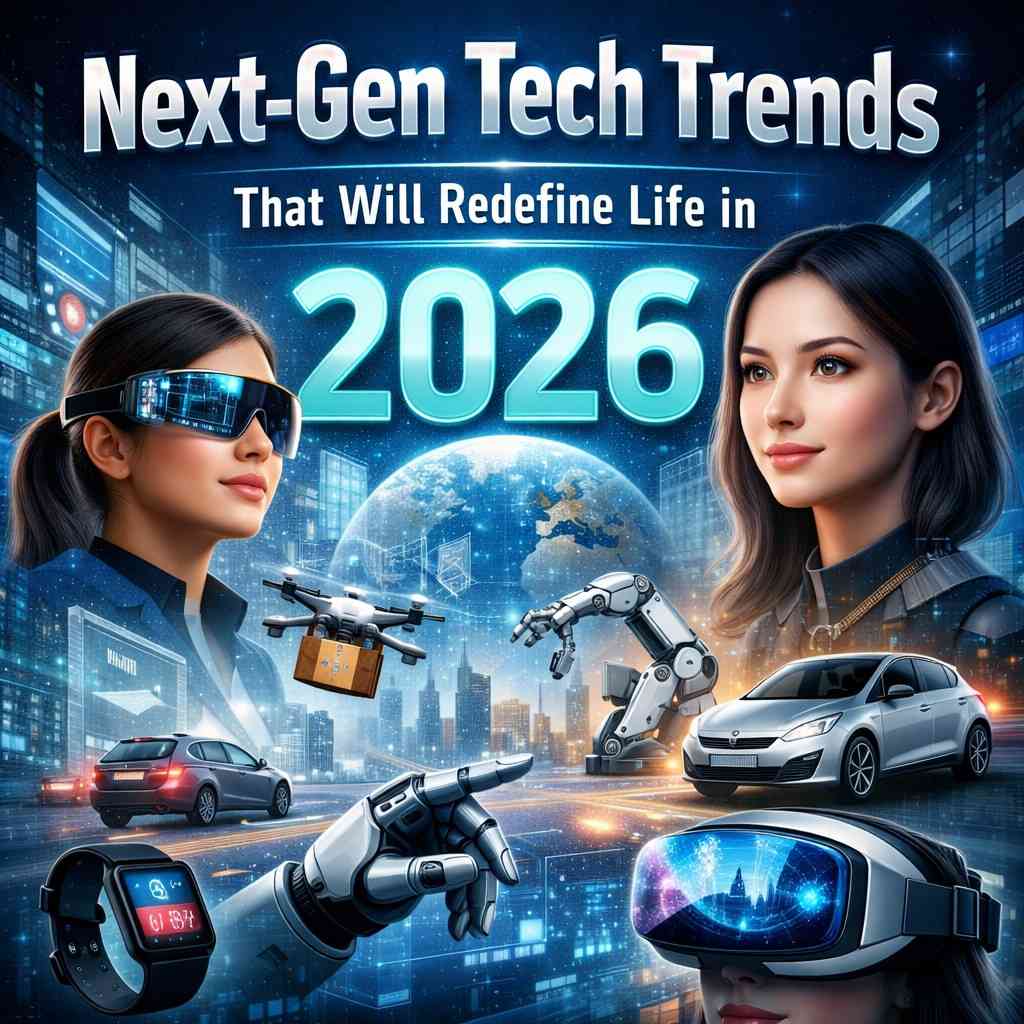
Unlike past tech revolutions that focused on single devices or platforms, 2026 will be defined by ecosystems—systems that connect software, hardware, data, and human behavior in seamless, almost invisible ways. From AI that understands context to machines that anticipate our needs, the next wave of technology will be less about novelty and more about dominance in daily life.
Below is a deep dive into the key technologies that will invade our lives in 2026, not as distant science fiction but as practical, unavoidable realities.
1. Ambient AI: Technology That Knows Without Asking
Artificial intelligence in 2026 will not wait for commands. Instead, it will exist in the background, observing patterns, predicting intent and acting proactively. This is known as ambient AI—intelligence embedded into environments rather than devices.
How ambient AI will shape everyday life:
- Homes that adjust lighting, temperature, and security based on your habits
- Work tools that summarize meetings, prioritize tasks and flag risks automaticallyDigital assistants that anticipate needs instead of responding to prompts
- Health monitoring systems that detect anomalies before symptoms appear
Unlike today’s chatbots and voice assistants, ambient AI will feel less like a tool and more like a silent partner. It will analyze context—location, time, behavior, preferences—to deliver decisions and recommendations without constant interaction.
The invasion factor: You won’t notice when it arrives, but you will immediately notice when it’s gone.
2. AI Companions and Digital Humans
By 2026, AI will no longer be faceless. Advances in natural language processing, emotional modeling and generative media will give rise to AI companions—digital entities designed to interact like humans.
Where AI companions will appear:
- Customer service agents that speak, react, and empathize
- Virtual coworkers handling research, reporting, and communication
- Personalized learning tutors adapting to student emotions
- Mental wellness companions offering guided support and conversation
These digital humans will remember preferences, adapt tone, and maintain long-term interaction histories. For many people, daily conversations with AI will feel just as natural as messaging a colleague.
Ethical tension:As emotional bonds form, the line between assistance and dependency will blur.
3. Smart Wearables That Monitor, Predict and Intervene
Wearable technology in 2026 will move far beyond step counts and heart rates. The next generation of wearables will be medical-grade, predictive, and always on.
What wearables will track:
- Blood sugar and hydration levels without needles
- Stress patterns using voice, posture, and biometric signals
- Sleep quality with predictive health alerts
- Early signs of chronic conditions or fatigue
These devices will not just collect data—they will act on it. Alerts will recommend rest, hydration, exercise or medical consultation before issues escalate.
Impact on lifestyle:Healthcare will shift from reactive treatment to continuous prevention, making technology a daily guardian of health.
4. Extended Reality (XR) Becomes Practical, Not Gimmicky
Virtual reality (VR), augmented reality (AR), and mixed reality (MR) will finally mature into Extended Reality (XR) ecosystems by 2026. The hardware will be lighter, cheaper and socially acceptable.
Everyday XR use cases:
- Virtual offices replacing video calls
- AR navigation layered over real streets
- Immersive product demos for shopping
- Hands-free training simulations for professionals
Instead of isolating users, XR will integrate with the physical world. Smart glasses will display contextual information without blocking reality.
The shift: Screens will no longer be objects you hold—they will become environments you step into.
5. Hyper-Personalized Everything
By 2026, personalization will go far beyond recommendations. With AI analyzing behavior across platforms, every experience will adapt in real time.
Examples of hyper-personalization:
- News feeds tailored to mood, not just interest
- Ads that change messaging based on intent and timing
- E-commerce stores with dynamic pricing and layouts
- Learning platforms adjusting pace and format instantly
This level of customization will make generic experiences feel outdated and inefficient.
The concern: As personalization increases, so does the risk of echo chambers and behavioral manipulation.
6. Autonomous Systems in Daily Operations
Autonomous technology will extend beyond self-driving cars. In 2026, autonomous systems will manage logistics, manufacturing, retail and even office workflows.
Where autonomy will dominate:
- Warehouses run by AI-coordinated robots
- Delivery drones and autonomous vehicles
- AI-driven supply chain forecasting
- Automated hiring and workforce optimization tools
Human involvement will shift from execution to oversight, strategy and ethics.
Economic reality:Roles will evolve rapidly, forcing large-scale reskilling across industries.
7. Smart Cities That React in Real Time
Cities in 2026 will operate as intelligent networks. Sensors, AI and real-time data will optimize how urban environments function.
Smart city features:
- Adaptive traffic systems reducing congestion
- AI-managed energy grids
- Predictive maintenance for infrastructure
- Public safety monitoring with real-time alerts
The city itself will become a platform, responding dynamically to population behavior and environmental conditions.
Trade-off:Efficiency will improve, but debates around surveillance and data ownership will intensify.
8. Biometric Identity Replaces Passwords
Passwords will increasingly disappear by 2026, replaced by biometric identity systems.
Common biometric methods:
- Facial recognition
- Voice authentication
- Fingerprint and palm scans
- Behavioral biometrics (typing, walking patterns)
This shift will make authentication faster and more secure—but also more permanent. Unlike passwords, biometric data cannot be changed once compromised.
Key challenge: Balancing convenience with irreversible privacy risks.
9. Generative Content Floods the Digital World
Generative AI will dominate content creation in 2026. Text, images, videos, music and even interactive experiences will be AI-generated at scale.
Where generative AI will be used:
- Marketing campaigns and ad creatives
- Product descriptions and e-commerce visuals
- Personalized entertainment experiences
- Training data and simulations
While this will reduce costs and speed up production, it will also create a flood of synthetic content, making authenticity harder to identify.
New skill demand: Human creativity will shift toward curation, storytelling, and strategy rather than execution.
10. Tech That Redefines Human Decision-Making
Perhaps the most profound invasion in 2026 will not be physical—it will be cognitive. AI will increasingly influence what we decide, when we decide, and why.
Decision areas impacted:
- Financial planning and investments
- Career recommendations
- Health and lifestyle choices
- Consumption and spending behavior
When algorithms consistently outperform human judgment, people will trust them more—even when they don’t fully understand how they work.
The ultimate question: Are we using technology to enhance human agency—or slowly surrendering it?
Conclusion:
The technology that will invade our lives in 2026 will not arrive as a single breakthrough. It will come as a slow, steady integration—a background presence shaping routines, decisions and expectations.
This invasion is not inherently negative. It promises efficiency, convenience, personalization, and improved quality of life. But it also demands awareness. As technology becomes more invisible and intelligent, the responsibility shifts to humans to define boundaries, ethics and intent.
2026 will not be the year technology takes over the world. It will be the year it becomes part of who we are.