Vikram-1 Rocket India’s First Private Orbital Rocket Set to Transform the Indian Space Industry
India’s space sector is entering a new era with the arrival of Vikram-1, the country’s first privately developed orbital launch vehicle. Developed by Skyroot Aerospace, Vikram-1 represents a significant milestone in India’s rapidly expanding commercial space ecosystem. Following the government’s decision to open the space sector to private companies, Indian startups have accelerated innovation, making affordable satellite launches a reality.
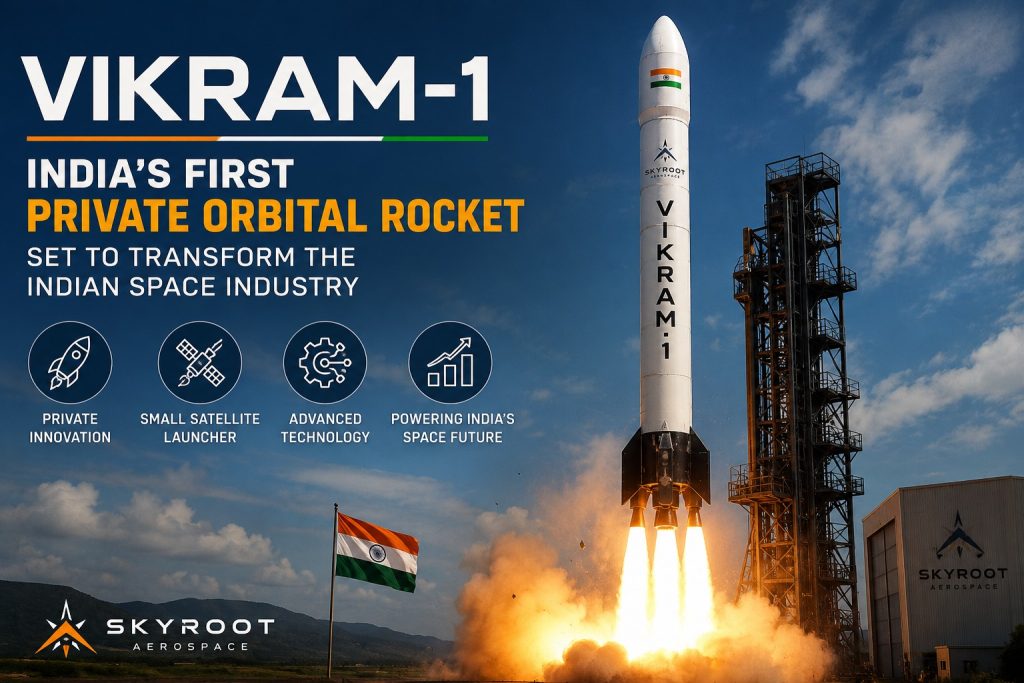
With the increasing global demand for small satellite launches, Earth observation, communication satellites, and defense applications, Vikram-1 is expected to position India as one of the world’s leading commercial launch destinations. This article explores everything you need to know about Vikram-1, including its technology, specifications, launch timeline, payload capacity, mission objectives, advantages, and future impact on India’s growing space economy.
What is Vikram-1?
Vikram-1 is India’s first privately built orbital launch vehicle developed by Skyroot Aerospace, a Hyderabad-based aerospace startup founded by former ISRO scientists. Named after Dr. Vikram Sarabhai, the father of the Indian space program, Vikram-1 has been designed to launch small satellites into Low Earth Orbit (LEO) at competitive costs.
Unlike traditional government-operated launch systems, Vikram-1 demonstrates how private companies can contribute to India’s ambitious space missions while supporting global satellite deployment needs.
Skyroot Aerospace: Driving India’s Private Space Revolution
Skyroot Aerospace has emerged as one of India’s most promising space technology startups. Established in 2018, the company aims to develop cost-effective launch vehicles capable of serving the rapidly growing small satellite market.
The company achieved national recognition after successfully launching Vikram-S, India’s first privately developed rocket, under the historic Prarambh Mission. Building on this success, Skyroot has developed Vikram-1 with advanced propulsion systems, lightweight carbon composite structures, and modular architecture designed for faster production and lower launch costs.
The startup works closely with IN-SPACe and leverages India’s growing commercial space ecosystem to compete globally.
Why Vikram-1 Matters for India
The launch of Vikram-1 is more than just another rocket mission. It symbolizes India’s transition from a government-dominated space program to a collaborative ecosystem where private innovation complements national capabilities.
As thousands of satellites are expected to be launched over the next decade, private launch providers like Skyroot can reduce waiting times, increase launch frequency, and attract international customers.
For India, this means:
- Increased foreign investment
- Higher export opportunities
- Employment generation
- Growth in aerospace manufacturing
- Expansion of satellite services
- Strengthening national security capabilities
The emergence of Vikram-1 also supports India’s ambition to become a leading global space economy.
Advanced Technologies Used in Vikram-1
Skyroot Aerospace has integrated several modern aerospace technologies into Vikram-1.
These include:
- Carbon Composite Structures: The rocket uses lightweight carbon fiber composite materials that improve structural strength while reducing overall mass.
- 3D Printed Components: Many engine components have been manufactured using additive manufacturing, reducing production time and manufacturing costs.
- Modular Design: The modular architecture enables faster assembly, easier maintenance and scalable production.
- Automated Manufacturing: Automation allows greater consistency and lower production expenses while increasing launch frequency.
Together, these innovations make Vikram-1 one of India’s most technologically advanced private launch vehicles.
Global Market Opportunity
The global small satellite industry is expanding rapidly. This growing demand creates significant commercial opportunities for launch providers like Skyroot Aerospace.
India’s competitive manufacturing costs combined with engineering expertise make Vikram-1 an attractive solution for international satellite operators.
Future of India’s Private Space Industry
India’s private space ecosystem is witnessing unprecedented growth, supported by policy reforms, government collaboration, startup funding and increasing investor confidence.
As more private companies enter the industry, India could become one of the world’s leading space technology hubs.
Vikram-1 is India’s first privately developed orbital launch vehicle by Skyroot Aerospace, designed to launch small satellites into Low Earth Orbit with cost efficiency and advanced technology. Featuring lightweight carbon composite structures, 3D-printed components, and modular design, Vikram-1 supports India’s expanding commercial space ambitions. It complements ISRO’s launch capabilities, opens new opportunities for global satellite customers, boosts India’s aerospace ecosystem, and strengthens the country’s position in the rapidly growing international space industry. With increasing demand for small satellite launches, Vikram-1 represents a major milestone in India’s private space revolution and future space economy.