18th BRICS Summit 2026 in India — Why the World is Watching
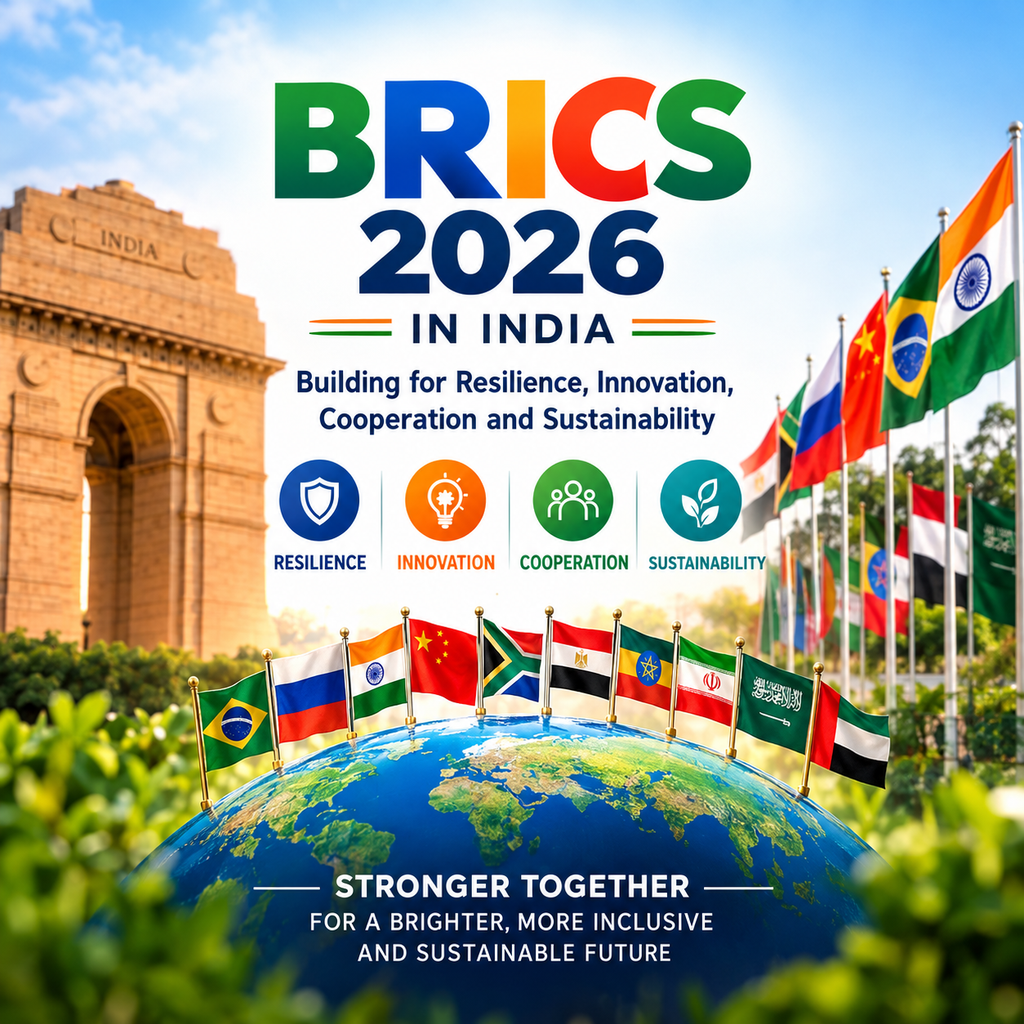
BRICS 2026 has been a significant year for India’s engagement with emerging economies and the wider Global South. India assumed the BRICS Presidency on 1 January 2026, marking its fourth time leading the grouping after 2012, 2016 and 2021. The year culminated in the 18th BRICS Summit in New Delhi on 12–13 September 2026, bringing leaders together under the theme “Building for Resilience, Innovation, Cooperation and Sustainability.“
For India, the 2026 presidency has provided an opportunity to focus BRICS cooperation on practical areas such as trade, technology, sustainable development, energy, agriculture, health, youth, women-led development and financial cooperation. At the same time, the expanded BRICS grouping represents a diverse set of economies with different national priorities, making consensus-building an important part of its functioning.
What Is BRICS?
BRICS is a forum for cooperation among major emerging-market economies. The grouping originally began with Brazil, Russia, India and China, with South Africa joining later. Its membership has since expanded substantially.
As of 2026, BRICS comprises 11 countries: Brazil, China, Egypt, Ethiopia, India, Indonesia, Iran, Russia, Saudi Arabia, South Africa and the United Arab Emirates. According to the Government of India, these members collectively represent around 49.5% of the world’s population, 40% of global GDP and 26% of global trade.
BRICS cooperation operates across three broad pillars:
- Political and security cooperation
- Economic and financial cooperation
- Cultural and people-to-people exchanges
Over the years, the agenda has expanded beyond traditional economic issues to include climate change, energy security, agriculture, technology, healthcare, education, digital transformation and sustainable development.
India’s BRICS 2026 Presidency
India officially assumed the BRICS Presidency at the beginning of 2026. The presidency gives the chair country an important role in setting priorities, organising meetings and coordinating discussions throughout the year.
India’s central theme for BRICS 2026 is: “Building for Resilience, Innovation, Cooperation and Sustainability.“
The four elements of the theme reflect the major areas India has highlighted during its presidency:
- Resilience: strengthening economies and institutions against global disruptions.
- Innovation: encouraging technology, research and new approaches to development.
- Cooperation: expanding practical collaboration among BRICS members.
- Sustainability: addressing climate, energy and development challenges.
India’s presidency has included hundreds of meetings and engagements across different Indian cities. The New Delhi Summit was the major culmination of this year-long programme. The government reported that more than 400 meetings and engagements involving ministers, officials, experts, businesses and other stakeholders were conducted across 30 cities during the 2026 chairship.
BRICS 2026 Summit in New Delhi
The 18th BRICS Summit was held in New Delhi on 12–13 September 2026. The summit brought together BRICS leaders to discuss cooperation across economic, political, technological and development-related areas.
The summit resulted in the BRICS New Delhi Declaration, which reaffirmed the group’s commitment to cooperation based on mutual respect, sovereign equality, solidarity, inclusiveness, collaboration and consensus. The declaration also emphasised sustainable development, inclusive growth and greater representation in global governance.
The summit was particularly significant because 2026 marks the 20th anniversary of BRICS. During the summit, members reiterated their interest in improving global governance institutions and strengthening multilateral cooperation.
The leaders also recognised the role of BRICS partner countries and the importance of greater engagement with emerging markets and developing countries.
Major Focus Areas of BRICS 2026
1. Economic and Trade Cooperation
Trade and investment have remained central to India’s BRICS presidency.
During the 16th BRICS Trade Ministers’ Meeting in Jaipur in August 2026, members discussed several initiatives aimed at improving trade cooperation, supporting MSMEs and developing more resilient global value chains.
Key areas included:
- Strengthening the multilateral trading system.
- Supporting small and medium-sized businesses.
- Improving access to trade finance.
- Expanding trade in services.
- Developing resilient and diversified global value chains.
- Supporting digitally delivered services.
- Progressing the BRICS Economic Partnership Strategy 2030.
One notable initiative was the Jaipur Consensus, which included work on an invoice discounting mechanism and guiding principles for credit assessment of export-oriented MSMEs. The objective is to explore ways of improving access to finance for smaller businesses participating in international trade.
2. Digital Economy and Technology
Technology has become an increasingly important component of BRICS cooperation.
India’s presidency placed considerable attention on digital transformation, innovation and resilient digital infrastructure. The BRICS Communications Ministers’ Meeting in August focused on cooperation in ICT, digital transformation, innovation and digital infrastructure.
Potential areas of cooperation include:
- Digital public infrastructure.
- Artificial intelligence.
- Cybersecurity.
- Digital services.
- Data-driven innovation.
- Digital connectivity.
- Technology standards.
- Cross-border digital trade.
The growing importance of technology also creates opportunities for startups, technology companies, researchers and entrepreneurs across BRICS economies.
3. Energy Security and Sustainability
Energy security was another important theme under India’s presidency.
India hosted the 11th BRICS Energy Ministers’ Meeting in Gurugram on 25–26 June 2026. Discussions focused on energy security, sustainability and innovation, including subjects such as artificial intelligence in the energy sector and carbon capture, utilisation and storage technologies.
The energy agenda included the broader objective of making energy systems:
- Secure
- Affordable
- Sustainable
- Accessible
- Technology-driven
- Future-ready
Energy cooperation is particularly relevant because BRICS includes major producers, consumers and importers of energy. Cooperation in this area can involve technology exchange, energy efficiency, renewable energy and research.
4. Agriculture and Food Security
Agriculture has also received greater attention during India’s 2026 presidency.
Among the initiatives emerging during the year were BRICS cooperation platforms focused on agro-ecology, digital agriculture and agricultural inputs. The government reported plans for a BRICS Network on Digital Agriculture, involving areas such as AI-enabled decision-making, geospatial technologies, IoT-based monitoring and data analytics.
Other initiatives include:
- BRICS Centres of Excellence on Agro-Ecology.
- Cooperation on seeds and genetic resources.
- Agricultural knowledge sharing.
- Climate-resilient farming.
- Digital agriculture.
- Sustainable agricultural practices.
These initiatives are particularly relevant for developing economies where agriculture remains closely connected to employment, food security and rural livelihoods.
5. Healthcare and Healthy Lifestyles
Healthcare has emerged as another area of practical cooperation.
During India’s BRICS presidency, members advanced cooperation around healthy lifestyles, traditional and complementary medicine, mental health and healthcare capacity building.
The BRICS Mission for Healthy Lifestyle and related roadmap for 2026–2029 were among the initiatives highlighted during the year. India also supported cooperation through networks involving healthcare institutions and centres of excellence.
The broader healthcare agenda includes:
- Preventive healthcare.
- Healthy lifestyles.
- Mental health.
- Traditional medicine.
- Healthcare research.
- Capacity building.
- Knowledge exchange.
6. Women and Youth Cooperation
India also placed significant emphasis on women and young people.
The BRICS Women Ministerial Meeting was held in Kochi in July 2026, with discussions focusing on women’s empowerment and inclusive, resilient and sustainable development.
Youth cooperation was another major component. India hosted the BRICS Youth Council Meeting and Youth Summit in Gandhinagar in August, followed by the BRICS Youth Ministers’ Meeting in Visakhapatnam.
Areas of focus included:
- Entrepreneurship.
- Innovation.
- Skills development.
- Youth participation.
- Women’s economic participation.
- Technology.
- Sustainable development.
7. Transport and Connectivity
Improved connectivity can support trade, tourism, investment and economic integration.
India hosted the 3rd BRICS Transport Ministers’ Meeting in Nagpur on 11–12 July 2026. The meeting focused on sustainability in infrastructure and mobility and explored cooperation around technological innovation and connectivity.
Transport cooperation can potentially contribute to:
- More efficient supply chains.
- Better regional connectivity.
- Sustainable transport.
- Infrastructure development.
- Technology sharing.
- Improved movement of goods and people.
- BRICS and the Global South
One of the broader themes of India’s BRICS presidency has been the role of emerging and developing economies in global governance.
The New Delhi Declaration reaffirmed BRICS members’ interest in a more representative and reformed multilateral system. It also highlighted cooperation with emerging markets and developing countries through the BRICS partner-country framework.
BRICS therefore provides a platform through which its members can coordinate positions on issues affecting developing economies, including:
- International trade.
- Development finance.
- Climate action.
- Technology access.
- Food and energy security.
- Global financial institutions.
- Sustainable development.
However, BRICS is a diverse grouping, and its members have different economic structures, foreign-policy priorities and national interests. As a result, cooperation often depends on consensus and practical areas where members can identify common interests.
BRICS 2026 and India’s Economic Opportunities
India’s BRICS presidency also creates opportunities for Indian businesses.
Greater cooperation among member countries could support businesses involved in:
- Information technology.
- Digital services.
- Pharmaceuticals.
- Agriculture.
- Renewable energy.
- Infrastructure.
- Manufacturing.
- Financial services.
- Logistics.
- Education.
- Tourism.
MSMEs are particularly relevant because India’s BRICS trade agenda has included initiatives aimed at improving their access to finance and international markets.
For Indian startups, universities and research organisations, increased collaboration can also create opportunities for partnerships, knowledge exchange and technology development.
The Role of the New Development Bank
Financial cooperation has been part of BRICS since the group’s earlier years. One of the most important institutional developments was the creation of the New Development Bank (NDB), which focuses on financing infrastructure and sustainable development projects.
India’s earlier BRICS presidencies contributed to the development of the group’s financial cooperation architecture, while the 2026 agenda continued discussions around economic and financial cooperation.
The broader objective is to strengthen development-oriented financing and cooperation among emerging economies while supporting infrastructure and sustainable development.
What Happens After India’s 2026 Presidency?
India’s BRICS presidency concludes with the New Delhi Summit, after which China will take the BRICS chairship in 2027 and host the 19th BRICS Summit. This transition was formally acknowledged in the New Delhi Declaration.
India’s 2026 presidency therefore represents one stage in the longer development of BRICS. The effectiveness of initiatives introduced or advanced during the year will depend on how successfully member countries implement them in subsequent years.
Conclusion
BRICS 2026 in India has placed the country at the centre of a year of diplomatic, economic and development-focused cooperation among major emerging economies. From the New Delhi Summit and trade discussions in Jaipur to meetings on energy, technology, transport, women and youth, India’s presidency has covered a broad range of issues.
The theme “Building for Resilience, Innovation, Cooperation and Sustainability” captures the main direction of India’s 2026 chairship. The initiatives discussed during the year show an emphasis on practical cooperation in areas such as trade, digital transformation, energy, agriculture, healthcare and sustainable development.
As BRICS moves into its next phase under China’s 2027 presidency, the implementation of these initiatives will be important. For India, the 2026 presidency has provided another platform to engage with emerging economies, promote cooperation on development priorities and participate in discussions about the future of global economic and political institutions.