Delhi Jantar Mantar Gen Z Protest 2026
The 2026 Jantar Mantar protest became one of the biggest student-led (Gen Z) demonstrations in recent years. The protests started on 6 June 2026 and were organized by the Cockroach Janta Party (CJP), a youth-led satirical political movement, along with student organizations such as the All India Students Federation (AISF), All India Students Association (AISA) and Students Federation of India (SFI). The main protest site was Jantar Mantar, New Delhi, where thousands of students and young people gathered to demand the resignation of Union Education Minister Dharmendra Pradhan over the alleged 2026 NEET paper leak and CBSE On-Screen Marking irregularities. The protesters also called for major reforms to improve transparency and fairness in public examinations.
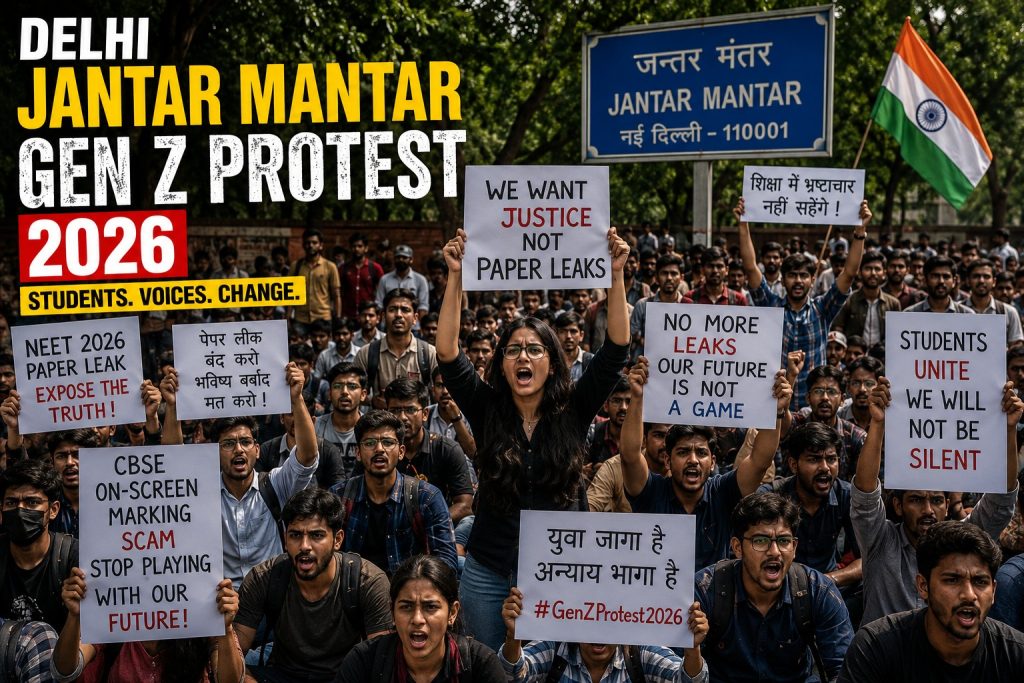
The movement gained nationwide attention when education reform activist Sonam Wangchuk joined the protest on 28 June 2026. He began an indefinite hunger strike at Jantar Mantar to support the students’ demands and urged the government to take responsibility for the examination issues. His participation brought significant public and media attention to the protest, with many students and citizens expressing support across the country.
Interestingly, the Cockroach Janta Party (CJP) first began as a social media campaign in May 2026. It was created by digital communication strategist Abhijeet Dipke as a form of political satire. The name “Cockroach” was inspired by remarks reportedly made by the Chief Justice of India, who compared unemployed youth and social media activists to “cockroaches” and “parasites.” The campaign quickly went viral online and soon transformed into a large-scale offline movement, with demonstrations taking place at Jantar Mantar after receiving initial permission from the Delhi Police.
In mid-July 2026, the situation became more tense. Following changes in the Delhi Police leadership, authorities removed barricades from the protest site and shifted Sonam Wangchuk to a hospital. Protest organizers claimed that he was taken against his wishes. Around the same time, another incident attracted media attention when a woman threw ink at Abhijeet Dipke while shouting pro-Hindutva slogans. These developments increased public interest in the ongoing demonstrations.
On 20 July 2026, thousands of students, young people, and Gen Z protesters gathered near Jantar Mantar, despite police instructions to disperse. Many protesters attempted to march towards Parliament, where the Monsoon Session was taking place. Police tried to stop the march by using barricades, baton charges, and tear gas. The clashes between protesters and police were widely reported by Indian and international media. While several international news organizations described the demonstrations as one of the largest anti-government protests in recent years, the Delhi Police stated that their actions were taken to maintain law and order.
After the police action, leaders of the Cockroach Janta Party announced that they would stop organizing street marches in Delhi. However, they confirmed that the peaceful sit-in protest at Jantar Mantar would continue until their demands were addressed. Soon after, police removed many of the temporary tents and camps set up by protesters. Despite heavy rain and difficult conditions, many demonstrators rebuilt their camps and continued the protest.
On 23 July 2026, Sonam Wangchuk ended his hunger strike after the government assured him that no legal action would be taken against protesters participating at the Jantar Mantar site. His decision was welcomed by supporters, who viewed it as a positive step towards dialogue between the protesters and the government.
Two days later, on 25 July 2026, Union Education Minister Dharmendra Pradhan resigned from his position. In his resignation letter addressed to the country’s youth, he stated that he had submitted his resignation to Prime Minister Narendra Modi in view of the situation that had developed at Jantar Mantar and across the country. He said he was taking moral responsibility for the issues surrounding the medical entrance examination while also defending the government’s handling of the overall situation.
The 2026 Jantar Mantar protests highlighted the growing role of students and young people in raising concerns about education, transparency and accountability. The movement also demonstrated how social media campaigns can evolve into large public demonstrations, bringing national attention to issues that affect millions of students. Regardless of differing political opinions, the protests became an important example of democratic participation and public engagement in India.