No More “10-Minute Delivery” Promises by Quick Commerce in India
In a major shift that could reshape the quick-commerce landscape in India, leading delivery platforms Blinkit, Zeptoand Swiggy’s Instamarthave agreed to drop their “10-minute delivery” promises from marketing materials, apps and branding. This move comes after significant government intervention over concerns about worker safety, working conditions and responsible marketing practices — triggering widespread discussion across industry, policy and gig-worker communities.
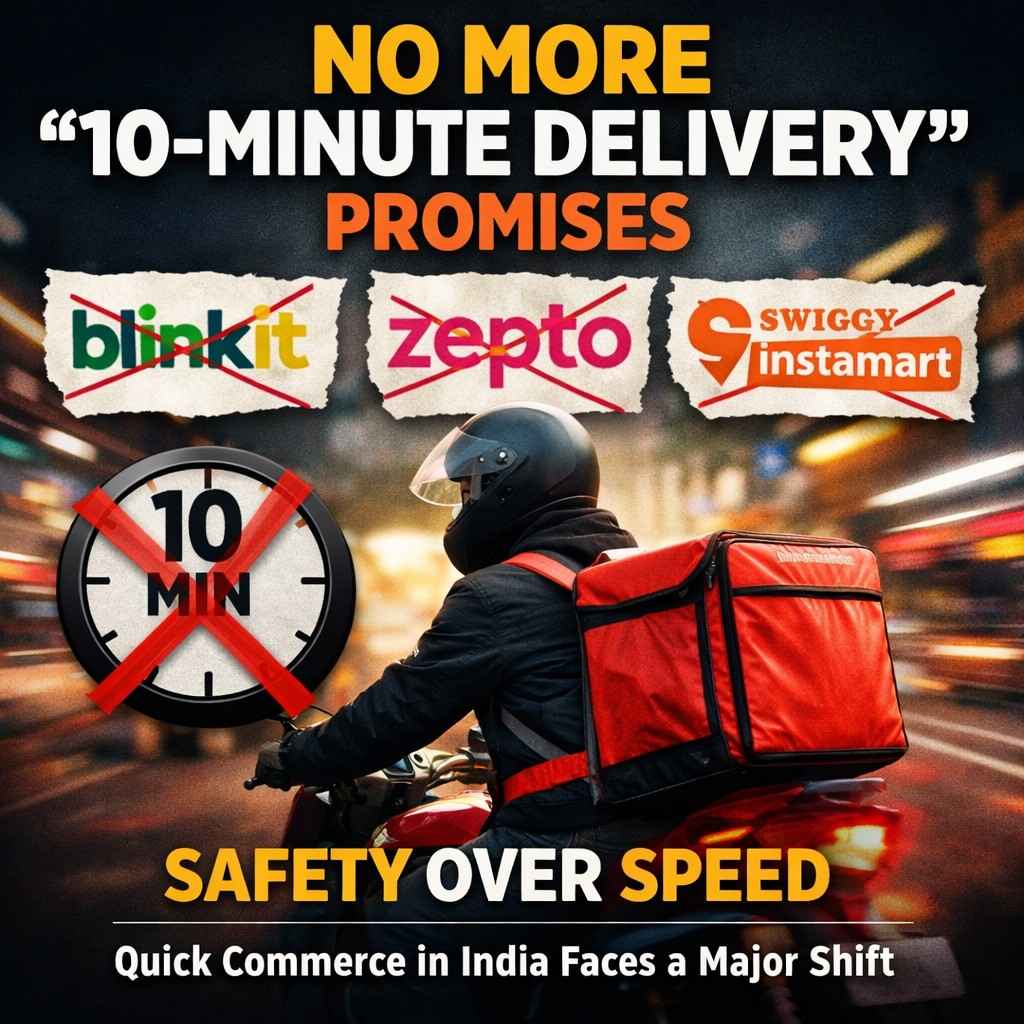
What was once one of the most eye-catching differentiators in Indian urban retail — groceries and essentials delivered within 10 minutes — now faces regulatory and ethical scrutiny. This article explores the background, reasons, industry reactions and broader implications of this shift.
“10-minute delivery” became a hallmark promise of quick-commerce (Q-comm) platforms in India starting around 2024. With dense networks of dark stores — small neighbourhood fulfilment centres — companies like Blinkit, Zepto and Swiggy Instamart sought to outcompete traditional e-commerce and grocery retail by offering an unprecedented speed of service. In major cities, customers quickly adopted these apps for urgent needs like groceries, cleaning supplies or snacks, with deliveries sometimes showing estimated times as low as 5–10 minutes.
This model was not just about speed: it was a bold marketing claim — a quick, sharp promise that stood out in a crowded market. It suggested operational efficiency and technological optimisation, backed by venture capital fuel and rapid expansion. Across social media and advertisements, “10-minute delivery” became synonymous with innovation in Indian urban logistics.
Despite its popularity with consumers, the promise of delivery within 10 minutes raised serious concerns — particularly around the conditions under which delivery and fulfilment workers operated.
In early 2026, India’s Union Ministry of Labour and Employment, led by Mansukh Mandaviya, intervened and urged quick-commerce firms to discontinue the 10-minute delivery branding on their platforms and marketing materials.
The ministry’s directive was grounded in concerns about road safety and labour welfare. Officials argued that strict time-bound delivery guarantees could create pressures — real or perceived — on delivery riders to rush through traffic or compromise on safety protocols. There is particular focus on how such deadlines may affect health, stress levels and working conditions for gig workers who already operate under flexible but often strenuous conditions.
Though neither the Centre nor the companies issued a formal public announcement initially, multiple reports — including from leading news agencies — confirmed that platforms had begun removing 10-minute claims following government discussions.
The issue gained wider attention after gig workers across India staged protests and strikes, notably a nationwide strike on New Year’s Eve 2025, calling for greater safety, fair wages and reasonable work expectations. The pressure from labour groups, unions and civil society highlighted the contrast between public marketing messages and the realities of delivery work.
Political actors also weighed in: AAP Rajya Sabha MP Raghav Chadha publicly backed the government’s move, arguing that when “10 minutes” is displayed on riders’ uniforms and screens, it creates constant pressure and dangerous conditions on public roads. His advocacy — including spending a day delivering orders himself — brought additional public scrutiny to gig-economy work conditions.
Among the platforms most closely associated with the 10-minute promise, Blinkit was the first to act.
The company removed all references to the 10-minute claim from its consumer apps and marketing, revising its tagline from “10,000+ products delivered in 10 minutes” to phrases like “30,000+ products delivered to your doorstep.“
Blinkit’s decision signalled that even ultra-fast delivery does not have to be defined by rigid, headline-grabbing time guarantees. The change comes at a time when the quick-commerce sector is under heightened public and regulatory scrutiny, and represents a willingness among at least some players to align with evolving labour expectations.
While Blinkit has already revised its branding, other major players like Zepto and Swiggy’s Instamart are expected to follow suit.
According to labour ministry sources and industry reports, Zepto and Swiggy have been urged — if not required — to phase out the 10-minute claim from their platforms in the coming weeks.
At the time of reporting, the 10-minute branding for these apps was still visible on some app stores, but insiders indicate upcoming changes are likely after government directives and sector-wide discussions.
At the heart of this shift is a broader debate about how much emphasis should be placed on speed versus safety and worker rights.
Ultra-fast delivery promises — even if not technically enforced by algorithms — can create implicit pressure for riders to prioritise speed over caution. Industry advocates and labour groups argue this could result in more road accidents, heightened stress, and a work culture that values speed over wellbeing.
The government’s intervention highlights a policy trade-off: while consumers appreciate fast service, regulators are increasingly unwilling to let marketing claims override worker safety and responsible operations.
Gig economy labour contracts often lack the protections afforded to traditional forms of employment, such as minimum wage guarantees, health insurance, or hazard pay. Critics of the 10-minute model say that tight delivery deadlines exacerbate these structural vulnerabilities.
Dropping such claims — and rethinking how delivery success is measured — could open the door to more humane work expectations, including fair compensation and realistic delivery targets aligned with safety norms.
For quick commerce platforms, redefining the delivery proposition away from “10 minutes or less” requires strategic adjustments.
Speed was once the defining differentiator in an increasingly crowded market. With that promise softening, platforms will need to focus on other value propositions such as variety, reliability, customer service, pricing, and overall delivery experience.
Blinkit’s updated tagline emphasises product range (“30,000+ products””) rather than speed — a pivot that signals a broader shift in marketing narratives within the industry.
Practical delivery times may still hover around short windows due to dense dark-store networks, but companies will likely de-emphasise rigid public promises that could be construed as guarantees. This could reduce litigation or regulatory risk while allowing logistical teams to prioritise sustainable delivery rhythms.
Customers — especially in urban India — have grown accustomed to fast delivery but may not notice immediate practical changes. Many users already experience delivery times longer than 10 minutes in real conditions due to traffic, rider availability, or order volume. Reddit and social chatter suggest that app-estimated times often differ from actual delivery durations, leading some consumers to view the 10-minute promise as more aspirational than guaranteed.
For users, this shift might be more symbolic than disruptive in daily life, while signalling a maturing quick-commerce market that balances speed with sustainability.
Dropping the 10-minute delivery claim marks a watershed moment for quick commerce in India — one where labour welfare and public safety take priority over headline-grabbing speed claims. It is also a reminder that rapid innovation often raises complex questions about the societal cost of convenience.
As industry, policymakers, and workers negotiate the future of urban logistics, the quick-commerce narrative is likely to evolve. Expect to see new norms that emphasise responsible delivery practices, meaningful worker protections, and more nuanced marketing that reflects real-world capabilities.
The era of “10-minute delivery” may be ending, but the era of fast, safe and sustainable commerce might just be beginning.