Independence Day 2026: India’s Journey Towards Viksit Bharat @2047 and the Rise of Yuva Shakti
India’s 80th Independence Day 2026 is more than a celebration of freedom; it represents a renewed national commitment to building a stronger, self-reliant and developed India. As the country marks Independence Day 2026, the focus is increasingly shifting from celebrating the achievements of the past to preparing for the opportunities and challenges of the future. The official campaign around Independence Day celebrations 2026 places particular emphasis on youth, innovation, national development and the long-term vision of Viksit Bharat @2047. This vision seeks to transform India into a developed nation by the centenary of its independence.
80th Independence Day 2026: A New Chapter for India
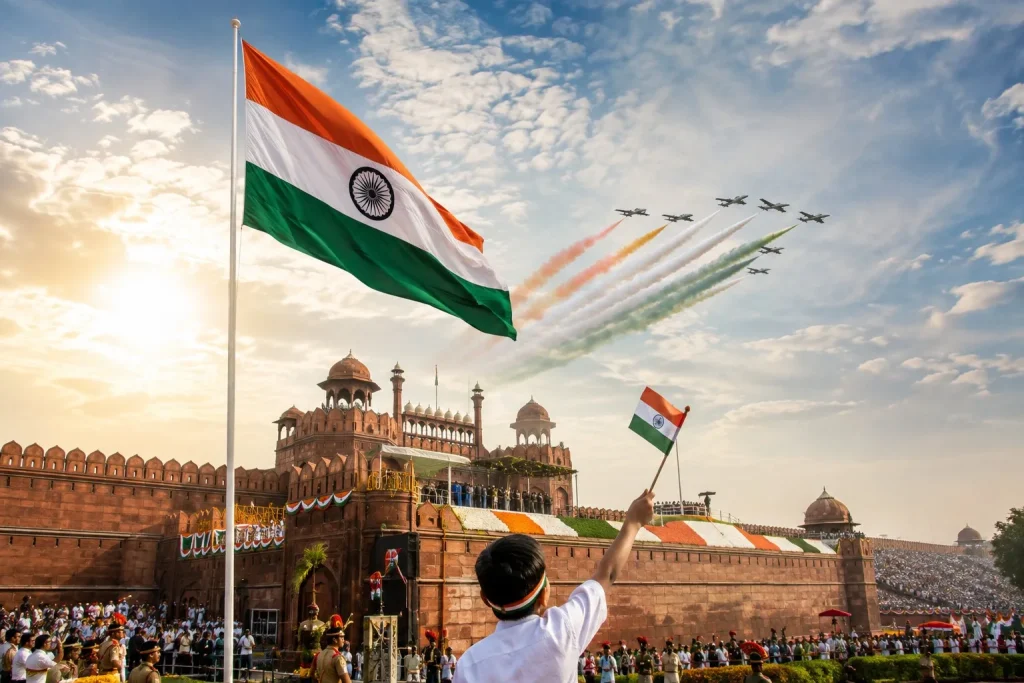
The 80th Independence Day of India carries special significance because it comes at a time when the country is positioning itself for its next major phase of economic and technological transformation. The celebrations at the Red Fort on August 15, 2026, were built around the themes of 150 years of Vande Mataram and Yuva Shakti for Viksit Bharat @2047. Prime Minister Narendra Modi led the national celebrations from the historic Red Fort, where he addressed the nation and presented a forward-looking roadmap for India’s development.
The significance of Independence Day India 2026 therefore goes beyond patriotic ceremonies. It reflects a broader national conversation about economic growth, technological capability, national security, infrastructure, energy independence, manufacturing and opportunities for India’s young population. The celebrations seek to connect the sacrifices of India’s freedom fighters with the responsibilities of today’s citizens in creating a prosperous and developed nation.
PM Modi Independence Day Speech 2026: A Vision for Viksit Bharat
The PM Modi Independence Day speech 2026 focused strongly on India’s next phase of development and the collective responsibility required to achieve Viksit Bharat 2047. The Prime Minister’s address from the Red Fort highlighted the need to strengthen India’s capabilities across multiple areas while ensuring that national interest remains central to the country’s development journey.
The Viksit Bharat 2047 vision is based on the idea that India’s transformation cannot depend on a single sector. Manufacturing, agriculture, technology, infrastructure, defence, energy, sustainability and India’s cultural influence all have important roles to play. This approach creates a broader development framework in which economic progress is connected with national capability, innovation and social opportunity.
Yuva Shakti for Viksit Bharat @2047
One of the most important themes of Independence Day 2026 is Yuva Shakti for Viksit Bharat. India’s young population represents one of the country’s greatest strategic advantages. The future of India’s economy, technology ecosystem, entrepreneurship, defence capabilities and global competitiveness will depend heavily on how effectively young Indians are educated, skilled and empowered.
The emphasis on youth contribution to nation building is particularly important in a rapidly changing global economy. Artificial intelligence, robotics, semiconductors, cybersecurity, digital services, biotechnology and advanced manufacturing are creating new career opportunities. India’s youth therefore have the opportunity not only to participate in these industries but also to build globally competitive companies and technologies from India.
The Prime Minister also announced an ambitious initiative to provide AI skills training to one crore young people within a year, highlighting the growing importance of artificial intelligence in India’s future workforce.
AI, Technology and Innovation: Building a Future-Ready India
The role of technology and innovation in India is becoming increasingly important as the country moves towards Viksit Bharat. Artificial intelligence, semiconductor manufacturing, digital infrastructure and emerging technologies are expected to influence India’s economic competitiveness over the coming decades.
The AI skills for youth initiative is significant because technology-driven economic growth requires a workforce capable of adapting to new tools and industries. AI education and digital skills can help students, professionals, entrepreneurs and job seekers participate in the emerging technology economy.
India’s semiconductor ambitions are another important part of the country’s technology strategy. During the PM Modi Independence Day speech 2026, the Prime Minister outlined plans aimed at expanding semiconductor manufacturing capacity, reinforcing India’s objective of becoming more self-reliant in critical technologies.
Atmanirbhar Bharat and India’s Self-Reliance
The idea of Atmanirbhar Bharat, or a self-reliant India, remains closely connected with the country’s long-term development ambitions. Independence Day 2026 highlights how self-reliance today means much more than producing traditional goods domestically. It increasingly involves developing advanced manufacturing capabilities, securing critical supply chains, strengthening energy security and creating globally competitive Indian products and services.
A self-reliant India can become a stronger participant in global markets while reducing excessive dependence on external sources for strategically important technologies and resources. This approach also creates opportunities for Indian startups, MSMEs, manufacturers, engineers and entrepreneurs to contribute to India’s growth story.
Sapta Dhara: Seven Streams of National Strength
A major feature of the Independence Day 2026 vision is the emphasis on multiple streams of national strength, described as Sapta Dhara. These include manufacturing power, agriculture and food production, technology and innovation, Gati Shakti, defence power, the green and blue economy, and India’s soft power.
This framework demonstrates that India’s development vision 2047 is intended to be comprehensive. Manufacturing can strengthen India’s industrial base, while agriculture remains essential for food security and rural prosperity. Technology can accelerate innovation, infrastructure can improve connectivity, defence can strengthen national security, and the green and blue economy can support sustainable development.
India’s soft power also has a major role to play. Indian culture, cinema, music, yoga, cuisine, literature and traditions already have international reach. Strengthening India’s cultural influence can complement its economic and technological rise.
Defence Technology and National Security
Another important focus of Independence Day 2026 is strengthening India’s defence capabilities. Modern national security increasingly depends on advanced technology, domestic manufacturing and innovation.
The government’s emphasis on defence technology in India, indigenous equipment and next-generation capabilities reflects the changing nature of security challenges. According to the Ministry of Defence, the Prime Minister highlighted Raksha Shakti as an important component of achieving the goal of Viksit Bharat and called for India to become a global supplier of next-generation defence technology.
Developing domestic defence technologies can create opportunities for Indian startups, research institutions, engineers and manufacturers while strengthening the country’s strategic autonomy.
Green Economy, Energy Security and Sustainable Growth
India’s journey towards Viksit Bharat 2047 also requires sustainable development. The green and blue economy, renewable energy, clean technologies and energy security are becoming increasingly important to India’s long-term economic strategy.
Energy independence is particularly significant because reliable and affordable energy supports manufacturing, transportation, digital infrastructure and economic growth. Investments in clean energy, nuclear power, renewable technologies and sustainable infrastructure can help India balance economic development with environmental responsibility.
The Independence Day 2026 vision therefore connects India’s economic growth and sustainability rather than treating them as separate priorities.
150 Years of Vande Mataram: Connecting History with the Future
The celebration of 150 years of Vande Mataram adds an important cultural and historical dimension to Independence Day 2026.
The patriotic song has long been associated with India’s freedom movement and national consciousness. This year’s celebrations bring that historical legacy into the present-day vision of nation building.
The message is particularly relevant for younger generations. Understanding India’s freedom struggle provides historical context for appreciating the responsibilities that come with independence. The challenge for today’s generation is different: instead of fighting colonial rule, citizens must work towards economic opportunity, technological leadership, social progress and national resilience.
What Independence Day 2026 Means for Every Indian
The significance of Independence Day 2026 ultimately extends beyond government programmes and national ceremonies. Viksit Bharat @2047 requires participation from citizens, entrepreneurs, students, farmers, scientists, workers, teachers, businesses and young innovators.
For students, it means acquiring future-ready skills. For entrepreneurs, it means creating products and companies that can compete globally. For businesses, it means investing in innovation and productivity. For professionals, it means continuously upgrading skills. For citizens, it means contributing to a stronger, cleaner, more responsible and self-reliant society.
The journey towards a developed India cannot be completed by government action alone. It requires a collective national effort in which individual aspirations become part of a larger development mission.
From Freedom to Future Readiness
India’s 80th Independence Day 2026 represents a powerful transition from remembering the struggle for freedom to defining the responsibilities of the next generation. The message of Viksit Bharat 2047, the focus on Yuva Shakti, the promotion of AI and emerging technologies, the push for self-reliance, stronger defence capabilities and sustainable development all point towards one central objective: building an India that is confident, capable and globally competitive.
As India moves towards 2047, the meaning of independence is evolving. Political freedom laid the foundation for the nation; economic strength, technological innovation, social progress and responsible citizenship can shape its future.
Independence Day 2026 is therefore not simply a day to look back at India’s journey. It is an opportunity to look ahead — and to ask what each of us can do to help build a Viksit Bharat by 2047.