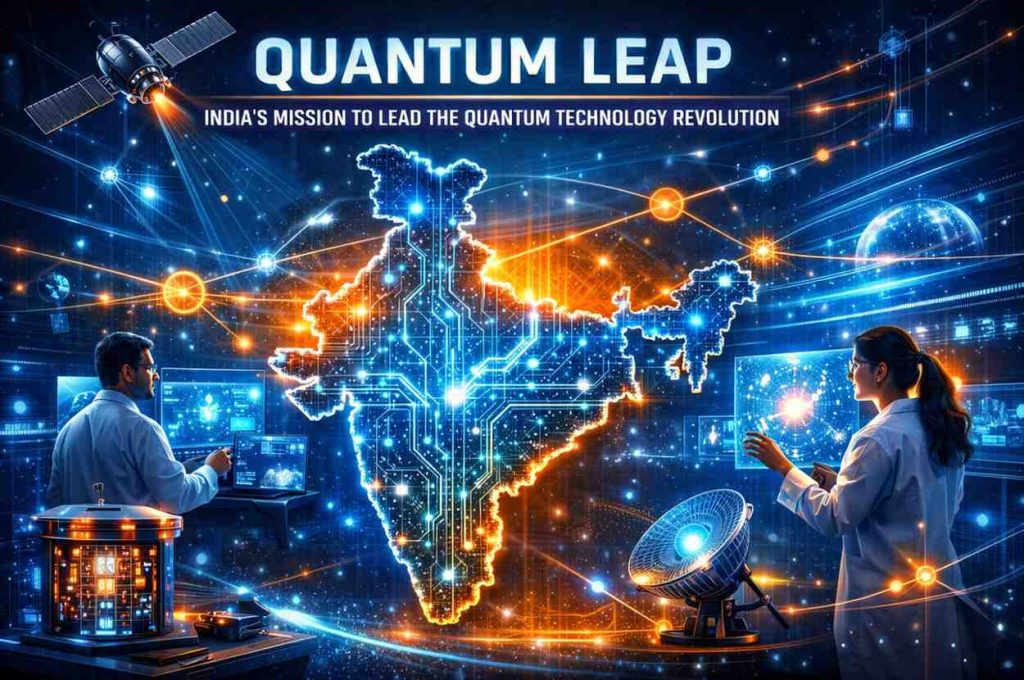
India’s Mission to Lead the Quantum Technology Revolution
Quantum Technology (QT) is no longer a futuristic concept confined to science fiction. It is rapidly becoming one of the most transformative technologies of the 21st century. Nations across the world are investing billions of dollars to gain leadership in quantum computing, quantum communication and quantum sensing. India, recognizing the immense strategic and economic importance of this field, has launched an ambitious national mission to position itself as a global quantum technology powerhouse. This mission represents not just technological progress but a bold step toward securing India’s digital sovereignty and scientific leadership.
Understanding Quantum Technology: Quantum Technology is built on the principles of quantum mechanics, a branch of physics that studies the behavior of matter and energy at atomic and subatomic levels. Unlike classical computers that use bits (0 or 1), quantum computers use quantum bits or qubits. These qubits can exist in multiple states simultaneously due to a phenomenon called superposition. Another key principle, entanglement, allows particles to remain interconnected regardless of distance, enabling ultra-fast data transmission and parallel computation.
These unique properties allow quantum systems to solve complex problems at speeds unimaginable for traditional computers. Tasks such as cryptographic analysis, molecular simulations, optimization problems, and climate modeling can be completed in minutes instead of years. As a result, QT is expected to revolutionize industries ranging from healthcare and finance to defense and space exploration.
Why Quantum Technology Matters for India: India’s interest in Quantum Technology is driven by both economic opportunity and national security needs. In today’s digital era, data protection, cyber security and communication infrastructure are critical. Quantum computing has the potential to break current encryption standards, which means countries that do not develop quantum-safe systems could face serious security threats.
At the same time, QT offers immense economic benefits. According to global estimates, the quantum industry could become a trillion-dollar market in the coming decades. By investing early, India aims to capture a significant share of this emerging sector, create high-skilled jobs, boost innovation and strengthen its position in the global technology ecosystem.
For a country with a strong IT workforce, world-class scientists and a growing startup ecosystem, Quantum Technology presents a natural next step in technological evolution.
India’s National Quantum Mission: To accelerate progress, the Government of India launched the National Quantum Mission (NQM) with a long-term vision of making India self-reliant in quantum technologies. The mission focuses on building indigenous quantum capabilities, strengthening research institutions and creating a robust innovation ecosystem.
The core objectives of the mission include developing quantum computers with increasing qubit capacity, establishing secure quantum communication networks, advancing quantum sensing technologies and nurturing a skilled quantum workforce. The initiative also emphasizes collaboration between academic institutions, government research organizations, startups, and private industry.
This structured approach ensures that India does not merely become a consumer of quantum technologies but emerges as a global producer and innovator.
Building Quantum Computing Capabilities: Quantum computing lies at the heart of India’s QT strategy. Researchers across Indian Institutes of Technology (IITs), Indian Institute of Science (IISc) and national laboratories are working on building scalable quantum processors. These efforts aim to develop fault-tolerant systems capable of solving real-world industrial and scientific problems.
India is also focusing on developing quantum algorithms tailored to local challenges. Applications such as traffic optimization, weather forecasting, financial risk analysis, and pharmaceutical research stand to benefit significantly. By integrating quantum computing with artificial intelligence and big data, Indian researchers are exploring hybrid models that can deliver powerful computational solutions.
In the long run, domestically built quantum computers will reduce dependence on foreign hardware and ensure strategic autonomy.
Quantum Communication and Cyber Security: One of the most promising areas of QT is quantum communication. Using quantum key distribution (QKD), it becomes possible to transmit data with near-perfect security. Any attempt to intercept quantum communication automatically alters the quantum state, making hacking virtually detectable.
India has already conducted successful experiments demonstrating secure quantum communication links over long distances. These developments are crucial for protecting sensitive government data, defense communications, banking networks, and critical infrastructure.
As cyber threats become more sophisticated, quantum-based encryption methods will play a vital role in safeguarding national and commercial digital assets. India’s early investment in this area gives it a strategic edge.
Advancing Quantum Sensing and Metrology: Quantum sensing uses quantum properties to measure physical quantities with extreme precision. This technology has applications in navigation, geological exploration, medical imaging and defense systems.
For example, quantum sensors can improve mineral exploration by detecting underground structures with high accuracy. In healthcare, quantum imaging techniques can enhance early disease detection. In defense, quantum radar and navigation systems can operate effectively even in GPS-denied environments.
India’s research institutions are actively exploring these applications, aiming to develop affordable and scalable quantum sensing solutions suited for domestic and global markets.
Role of Startups and Industry Collaboration: India’s vibrant startup ecosystem is playing an important role in the quantum revolution. Several deep-tech startups are working on quantum software, encryption tools, hardware components and cloud-based quantum services. These companies are collaborating with universities and global research labs to bring innovation from the laboratory to the marketplace.
Large technology firms and public sector enterprises are also investing in quantum research partnerships. Such collaborations help bridge the gap between academic research and commercial deployment. By encouraging public-private partnerships, India is building a sustainable innovation pipeline that can accelerate product development and global competitiveness.
This industry-driven momentum is essential for translating government vision into real economic impact.
Developing a Skilled Quantum Workforce:A critical challenge in Quantum Technology is the shortage of skilled professionals. QT requires expertise in physics, mathematics, computer science and engineering. Recognizing this, India is investing heavily in education and training programs.
Universities are introducing specialized quantum computing courses, research fellowships, and interdisciplinary programs. Online learning platforms and government-sponsored initiatives are helping professionals upskill in quantum programming and theory.
By nurturing talent at the academic and industry levels, India aims to create a workforce capable of driving long-term innovation and sustaining leadership in quantum research.
Global Competition and India’s Strategic Position: Countries such as the United States, China and members of the European Union are aggressively investing in quantum technologies. This has created a global race for quantum supremacy. While India entered this race later than some nations, its structured national mission and strong research base provide a solid foundation for rapid growth.
India’s advantage lies in its cost-effective research environment, large talent pool, and experience in scaling digital technologies. With the right policy support and international collaboration, India has the potential to become a major global hub for quantum innovation.
Strategic partnerships with friendly nations and participation in global quantum research networks further strengthen India’s position.
Challenges on the Road Ahead: Despite impressive progress, the quantum journey is not without challenges. Building stable quantum hardware is technically complex and expensive. Maintaining qubit stability, reducing error rates, and scaling systems remain major scientific hurdles.
There is also a need for consistent funding, infrastructure development, and long-term policy continuity. Coordination between multiple stakeholders — government bodies, research institutions, and private companies — must remain strong to avoid fragmentation of efforts.
However, these challenges are not unique to India. They are part of the global learning curve associated with cutting-edge technologies.
The Future of Quantum Technology in India:The future of Quantum Technology in India looks promising. Over the next decade, quantum computing is expected to move from experimental labs to commercial applications. Indian enterprises will increasingly adopt quantum solutions to improve efficiency, reduce costs, and gain competitive advantages.
From smart cities and precision agriculture to drug discovery and climate modeling, QT will influence almost every major sector. As these technologies mature, India’s early investments will begin delivering tangible economic and strategic benefits.
Most importantly, quantum advancement will strengthen India’s technological sovereignty and innovation ecosystem.
Conclusion
India’s mission to become a Quantum Technology power represents a defining moment in its scientific journey. By combining government support, academic excellence, startup innovation, and industry collaboration, the country is laying the foundation for a quantum-enabled future.
Quantum Technology is not just about faster computers — it is about redefining how humanity processes information, secures data, and understands the universe. As India takes its quantum leap, it is positioning itself not only as a participant but as a leader in shaping the next era of global technological progress.
The quantum revolution has begun, and India is determined to be at the forefront.